
Practical workflow guides
How to reply to every new lead in minutes
How fast should you reply to a new lead? What the research says, and how an AI employee replies at once and drafts each follow-up for you to approve.
Send a short first reply the moment a lead comes in, and text back every missed call. Then send a personal follow-up that offers times you're free.
An AI employee drafts that follow-up, and someone you name approves it before it sends. The one exception is a message you write and approve once, like the first reply to a new lead.
A 2011 Harvard Business Review study tracked 1.25 million leads. Firms that tried to reach a lead within an hour were nearly 7 times as likely to talk with a decision maker as firms that tried an hour later.
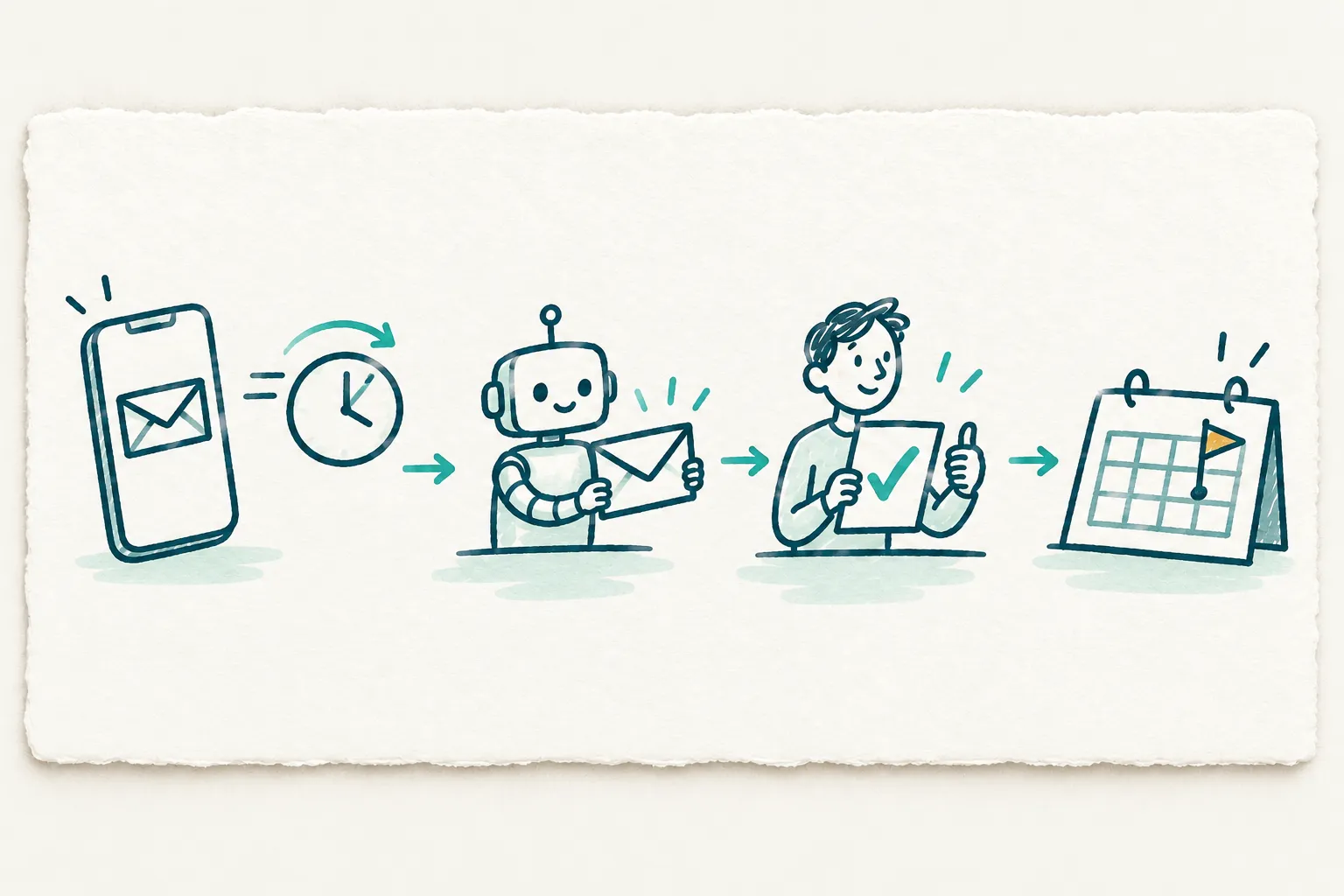
How the workflow can work
- A lead comes in
It can come from a web form, an email, a text or a missed call. The AI employee sees each one and passes anything urgent to whoever is on call.
- Your first reply goes out
Right away, it sends the short message you wrote and approved once. Missed calls get it as a text. It never quotes a price or promises a date.
- A follow-up gets drafted
The AI employee reads the lead's message, your notes and your calendar. Then it drafts a personal reply that offers times you're free.
- A person approves it
You, or someone you name, check the draft and send it. Then the lead books one of the times it offers.
Questions to answer before implementation
Where do your leads come in today, and who sees them first?
How fast do you reply now, on weekdays, nights and weekends?
What may the first reply say, and what must it never say?
Who should approve the follow-ups, and how soon must they go out?
What counts as an emergency, and who is on call?
Which calendar shows when you're really free?
Which jobs and areas do you take, and which leads get a polite no?
Did these leads agree to hear from you by text?
What to define in the implementation scope
A first reply to every new lead, sent the moment it arrives, in words you approved
Missed calls texted back right away, so callers know you got the message
Personal follow-ups drafted from your notes and calendar, waiting for your OK
Urgent requests passed to whoever is on call
Your time to a personal reply, measured against where you started in the Diagnostic
These are proposed workflow outputs, not a promise of results or a fixed monthly deliverable.
Map the work before implementing it.
The free Snapshot helps choose one workflow. The paid Diagnostic documents the current process, baseline, ownership, decisions and proposed scope. Nothing is built during the Diagnostic. Implementation requires a separate written scope.
AI Operations Snapshot: Free. AI Operations Diagnostic: $1,000 once for 1 week, documents only; no implementation is included. Partnership Tiers: Direct Advisory at $2,500/month with 4 engineering hours a month; Strategic Partner at $4,500/month with 8 engineering hours a month; Fractional Product Lead at $7,500/month with 15 engineering hours a month. Each tier has a 3-month commitment and no onboarding fee. Sprint Add-Ons cost extra and require an active Partnership Tier.
It renews for another 3 months at the same price unless you give 30 days' notice before it ends. Renewal reminders and written notice follow the agreement. Licenses, hosting and AI usage are billed separately by the relevant vendors.
Questions owners ask first
- How quickly should you respond to a new lead?
Within minutes if you can, and within the hour at most. In a 2011 Harvard Business Review test of 2,241 US companies, only 37% replied to a web lead within an hour. And 23% never replied.
- Is the 5-minute rule for leads real?
Partly. Its famous numbers come from a 2007 vendor study of six companies' phone data, not from Harvard. Harvard Business Review's 2011 study measured hours, and the first hour mattered most. Five minutes is still a good goal.
- What happens when I miss a customer's call?
Many won't wait. In CallRail's 2025 survey of 1,000 US consumers, only 42% said they leave a voicemail. And 21% said they call another business right away. A text back at once tells them you got the call.
- How should I handle leads that come in after hours?
Let your approved first reply go out at any hour, so nobody waits until morning to hear from you. Emergencies go straight to whoever is on call. The follow-up draft waits in your queue until morning.
- Should I get an AI receptionist or an answering service?
If callers need a live voice, hire an answering service. An AI receptionist answers at once, but some callers hang up on a bot. We don't put AI voices on your phone. Missed calls get your approved text instead.
- Is it OK to send an automatic first reply to a new lead?
Yes, if it sounds like you and says what happens next. Keep it short, and write and approve it once. It doesn't replace a personal reply. The AI employee drafts that one, and someone you name approves it.