
Practical workflow guides
How to get plain answers from your own numbers
Can AI answer questions about your QuickBooks and spreadsheets, and can you trust it? Get plain-English answers, with a named person checking the numbers.
Ask questions in plain English, and get answers from your own QuickBooks, CRM and spreadsheets. Each week, you also get a short summary of what changed.
AI can get numbers wrong, so a named person checks each figure before anyone acts on it. The AI employee also drafts notes fitted to each client's history, for a person to approve.
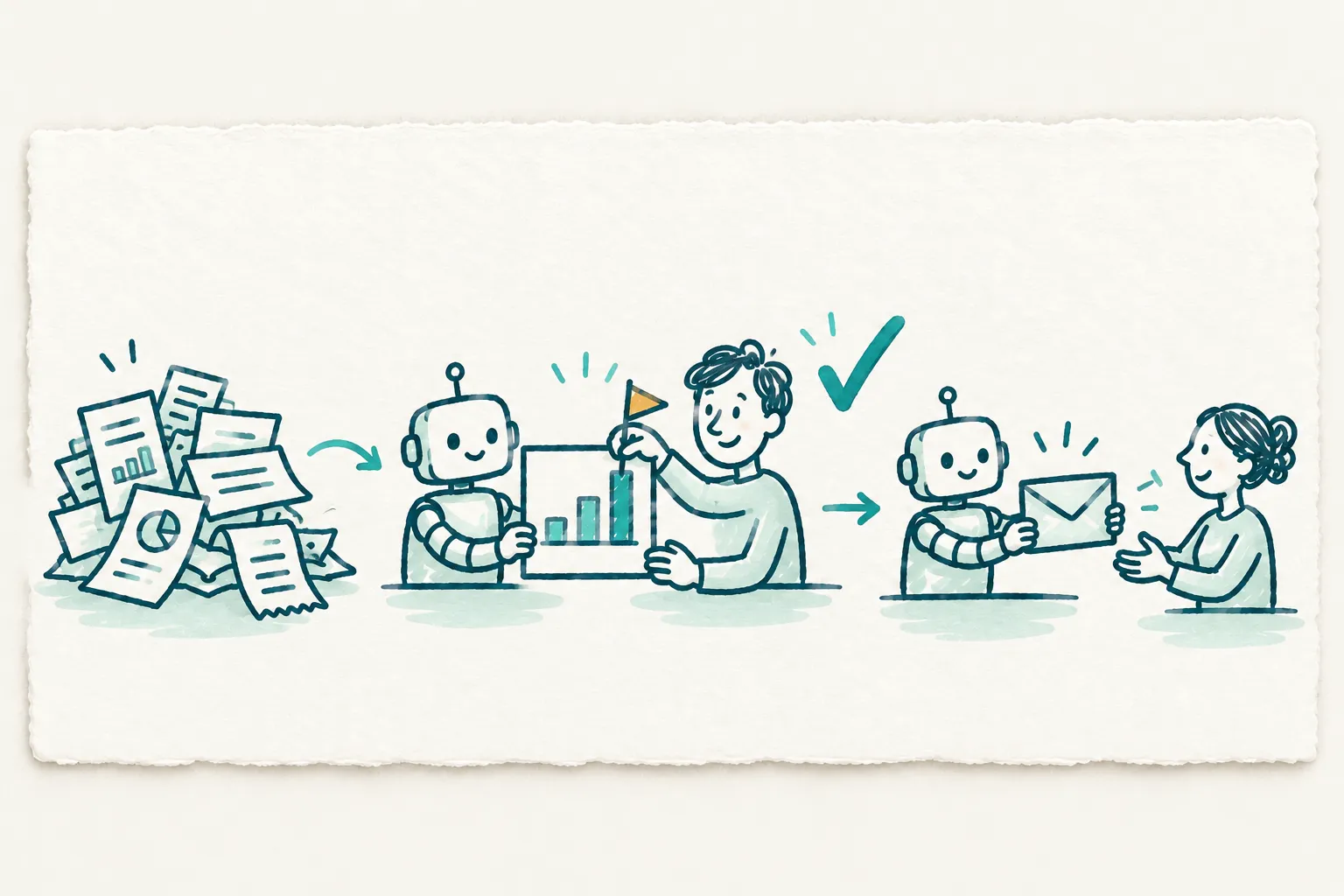
How the workflow can work
- Your data gets connected
The AI employee gets read-only access to QuickBooks, your CRM and the spreadsheets you choose. It can read them, not change them.
- You ask in plain English
Ask a question like which clients slowed down this quarter. It answers from your own data and shows the numbers it used.
- A weekly summary gets checked
Each week it drafts a short summary of what changed. A named person checks the numbers before anyone acts on them.
- Client notes get drafted
When the data shows a client to contact, it drafts a note fitted to that client's history. A person approves it before it sends.
Questions to answer before implementation
What decisions should these numbers help you make?
Who will read the answers, and what should they do differently?
Which numbers do you check first, and which do you wish you had?
Where does your data live today, and who keeps each source current?
How fresh must the numbers be, daily or weekly?
Who may see which data, and how is it kept secure?
How is your client data set up in your CRM today?
What do clients get in return for the data you use to write to them?
What to define in the implementation scope
Plain-English answers from your own QuickBooks, CRM and spreadsheets
A weekly summary of what changed, checked by a named person before anyone acts on it
Notes fitted to each client's history, each approved before it sends
A permission register showing what the AI employee can read, and who approved it
The time your reports take, measured against where you started in the Diagnostic
These are proposed workflow outputs, not a promise of results or a fixed monthly deliverable.
Map the work before implementing it.
The free Snapshot helps choose one workflow. The paid Diagnostic documents the current process, baseline, ownership, decisions and proposed scope. Nothing is built during the Diagnostic. Implementation requires a separate written scope.
AI Operations Snapshot: Free. AI Operations Diagnostic: $1,000 once for 1 week, documents only; no implementation is included. Partnership Tiers: Direct Advisory at $2,500/month with 4 engineering hours a month; Strategic Partner at $4,500/month with 8 engineering hours a month; Fractional Product Lead at $7,500/month with 15 engineering hours a month. Each tier has a 3-month commitment and no onboarding fee. Sprint Add-Ons cost extra and require an active Partnership Tier.
It renews for another 3 months at the same price unless you give 30 days' notice before it ends. Renewal reminders and written notice follow the agreement. Licenses, hosting and AI usage are billed separately by the relevant vendors.
Questions owners ask first
- Can ChatGPT analyze a spreadsheet?
Yes. ChatGPT reads an uploaded file by writing and running code, and Copilot works inside Excel. Clean tables with clear column names work best. Microsoft's own advice is to verify anything Copilot creates before you rely on it.
- Is it safe to upload financial data to ChatGPT?
Use approved business tools with the access, retention and model-training settings checked for your engagement. Give each assistant only the records its job needs. A person reviews every generated output before it leaves the review queue.
- Is ChatGPT data analysis accurate?
Sums and simple summaries are usually right. Counts, statistics and big files often aren't. On Vals AI's test of 537 entry-level finance tasks, the best model got 64.37% right in June 2026. So a person checks its work.
- Which KPIs should a small business track?
Pick a few that tie to a goal, and check them on the same day each week. Good ones to start with are cash flow, profit margin, repeat clients, leads by source and how many leads become clients.
- Can AI answer questions about my QuickBooks data?
Yes. Since October 2025, Intuit's own AI answers business questions inside QuickBooks for US users. Third-party connectors can also link QuickBooks to ChatGPT. Live links beat pasted exports, which go stale. Check answers before you act.
- How do I personalize emails to each client?
Use what you know about each client, like their last job and what they asked about. An AI employee drafts each note from that history, in your voice. A person approves it before it sends.