Practical workflow guides
How to walk into every sales call prepared
How much of your week goes to prepping for calls and reviewing them? An AI employee writes the brief before each call and drafts the follow-up for you to approve.
Before every booking on your calendar, an AI employee pulls past emails, notes and company details into a one-page brief.
After the call, it scores the transcript against your checklist and drafts the follow-up. A person approves the follow-up before it's sent.
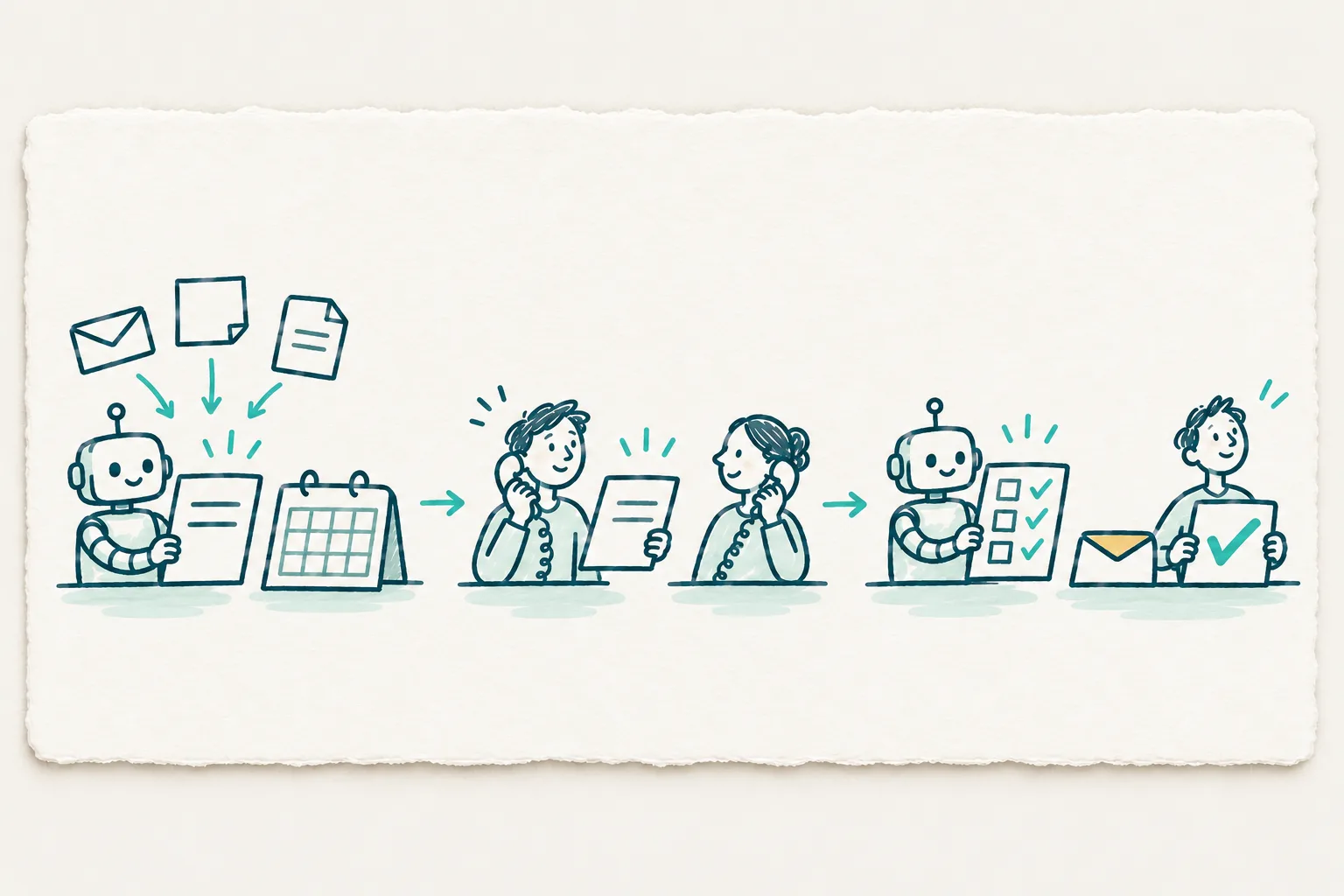
How the workflow can work
- A booking starts the brief
When a call lands on your calendar, the AI employee gathers past emails, notes, quotes and public company details.
- The brief is ready before the call
A one-page brief waits in The Synergy Hub, with open questions and anything promised before.
- The call is reviewed against your checklist
With everyone's consent to record, the AI employee scores the transcript against your checklist and notes what was missed.
- The follow-up waits for approval
It drafts the follow-up and the next step. A person approves it before it's sent, and coaching notes go to the person who ran the call.
Questions to answer before implementation
Where do your sales calls get booked?
Where do past emails, notes and quotes live?
Do you record calls today, and how do you get consent?
What does a good sales call cover, step by step?
Who writes the follow-up today, and how long after the call?
Who reviews call scores and coaching notes?
What must a follow-up never promise without your approval?
How will you measure it: calls to proposals, proposals to wins, or time saved?
What to define in the implementation scope
A one-page brief before every booked call
A written call checklist, scored on every recorded call
Follow-up drafts that a named person approves before they're sent
A recording-consent step that fits the law where you and your callers are
Prep and follow-up time, measured against where you started in the Diagnostic
These are proposed workflow outputs, not a promise of results or a fixed monthly deliverable.
Map the work before implementing it.
The free Snapshot helps choose one workflow. The paid Diagnostic documents the current process, baseline, ownership, decisions and proposed scope. Nothing is built during the Diagnostic. Implementation requires a separate written scope.
AI Operations Snapshot: Free. AI Operations Diagnostic: $1,000 once for 1 week, documents only; no implementation is included. Partnership Tiers: Direct Advisory at $2,500/month with 4 engineering hours a month; Strategic Partner at $4,500/month with 8 engineering hours a month; Fractional Product Lead at $7,500/month with 15 engineering hours a month. Each tier has a 3-month commitment and no onboarding fee. Fixed-Scope Builds: Workflow Automation $3,500; Team System $7,500; Operations System $14,500; Business Platform $25,000–$50,000, one time, at a fixed price.
It renews for another 3 months at the same price unless you give 30 days' notice before it ends. Renewal reminders and written notice follow the agreement. Licenses, hosting and AI usage are billed separately by the relevant vendors.
Questions owners ask first
- How much time do salespeople actually spend selling?
Less than half. Salesforce's 2026 State of Sales research surveyed 4,050 sales professionals in August and September 2025. It found the average seller spends 40% of their time selling, and Gen Z reps just 35%.
- Is it legal to record sales calls in Washington State?
Only with everyone's consent. Federal law allows recording when one party consents, but Washington's RCW 9.73.030 requires consent from all participants. Announcing the recording counts, if the announcement is recorded too. This isn't legal advice.
- Does sales coaching improve results?
It can, but not evenly. Field experiments at two companies, published in the Journal of Marketing, found middle-ranked agents improved most with an AI coach. Top and bottom performers gained little alone, and did best with AI and a human coach together.
- What goes into a pre-call brief?
Who they are, how they found you, past emails and notes, what they asked about, and any open quote. It fits on one page, so you can read it in the two minutes before the call.
- How is a sales call scored?
Against your own checklist, written with you: did the call confirm the problem, the budget, who decides and the next step? The AI employee marks what was covered and quotes the moment, for a person to review.
- Does the follow-up email go out automatically?
No. The AI employee drafts the follow-up from the call and your notes. You, or someone you name, edits it if needed and approves it before it's sent.