Practical workflow guides
How to stop every decision from landing on your desk
What happens when every quote, check and client update has to pass through the owner? Written rules and AI employees let your team handle more without you.
We turn the standards in your head into written rules, then into AI employees inside The Synergy Hub that draft the routine work against those rules.
Your existing team handles more without adding payroll. The decisions that truly need you still come to you.
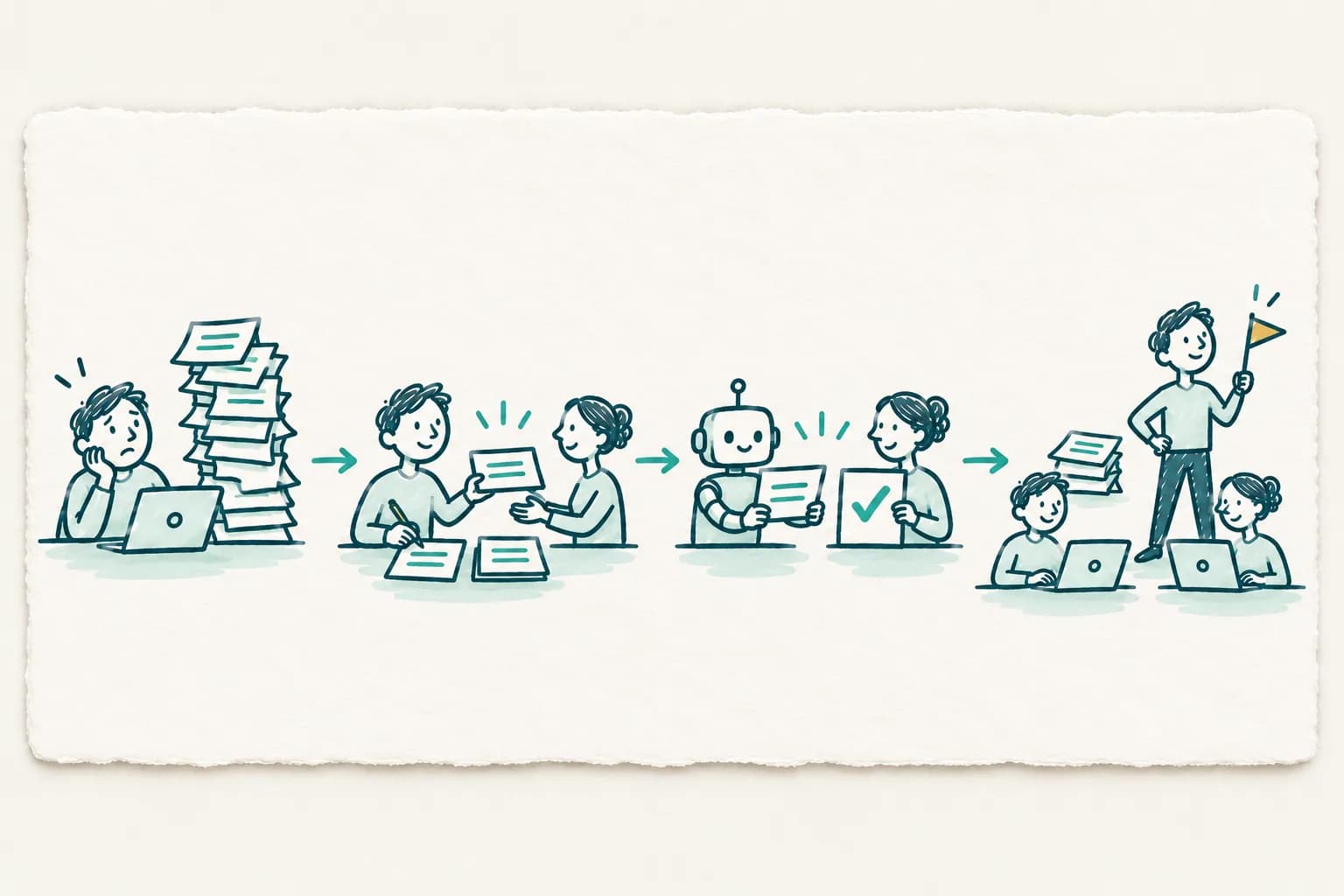
How the workflow can work
- Count what reaches you
For one normal week, log every quote, check and question that waits on you. The Snapshot prices it as your Owner Tax.
- Write the rules
Turn the most common decisions into written rules with clear limits, so your team can make them without asking.
- AI employees apply them
Inside The Synergy Hub, AI employees draft quotes, checks and client updates against the rules. A named person approves each one.
- Exceptions still reach you
What the rules don't cover comes to you. Each new answer can become a rule, so fewer come back.
Questions to answer before implementation
Which decisions wait on you most in a normal week?
Which of those could a written rule settle?
What limits would you set on discounts, rush fees and refunds?
Who on your team could approve work against those rules?
Which jobs only you know how to do, and what breaks when you're away?
What must always come to you, whatever the rule says?
How many hours a week do you spend on work your team should handle?
What would you do with those hours back?
What to define in the implementation scope
Written rules for the decisions that wait on you most
AI employees that draft routine work against those rules, each with a named approver
A clear list of what still comes to you
The work your team now handles without you, counted each month
Owner hours on routine decisions, measured against where you started in the Diagnostic
These are proposed workflow outputs, not a promise of results or a fixed monthly deliverable.
Map the work before implementing it.
The free Snapshot helps choose one workflow. The paid Diagnostic documents the current process, baseline, ownership, decisions and proposed scope. Nothing is built during the Diagnostic. Implementation requires a separate written scope.
AI Operations Snapshot: Free. AI Operations Diagnostic: $1,000 once for 1 week, documents only; no implementation is included. Partnership Tiers: Direct Advisory at $2,500/month with 4 engineering hours a month; Strategic Partner at $4,500/month with 8 engineering hours a month; Fractional Product Lead at $7,500/month with 15 engineering hours a month. Each tier has a 3-month commitment and no onboarding fee. Fixed-Scope Builds: Workflow Automation $3,500; Team System $7,500; Operations System $14,500; Business Platform $25,000–$50,000, one time, at a fixed price.
It renews for another 3 months at the same price unless you give 30 days' notice before it ends. Renewal reminders and written notice follow the agreement. Licenses, hosting and AI usage are billed separately by the relevant vendors.
Questions owners ask first
- How many hours do small business owners work?
Many work long weeks. In Adobe's 2025 Work-Life Balance Report, more than one in five of the 632 small business owners surveyed said they work more than 50 hours a week. It's a vendor survey, not government data.
- Do business owners who delegate grow faster?
Gallup's research suggests so. In a 2015 study of 143 Inc. 500 CEOs, those with high delegator talent posted three-year growth 112 percentage points higher than low delegators. That shows a link, not proof that delegating caused it.
- Are other businesses using AI to add capacity?
Many plan to. Microsoft's 2025 Work Trend Index surveyed 31,000 workers in 31 markets. 80% said they lack the time or energy to do their work, and 82% of leaders were confident they'd use digital labor to expand workforce capacity.
- How do I get decisions off my desk?
Write down the rules you already use: when you'd give a discount, what a good quote looks like, who can approve a rush job. Start with the decision that waits on you most. Your team uses the rule, and only exceptions come back.
- What should still come to the owner?
Anything the written rules don't cover, anything above a limit you set, and anything that changes a price, a refund or payroll. Those stay with you or a person you name.
- Will this replace my staff?
No. The point is to let the team you have handle more. AI employees draft the routine work. Your people review it, make the decisions and talk with clients.