Practical workflow guides
How to publish consistently without sounding like AI
How do you publish consistently without sounding like generic AI? An AI employee drafts posts from your own calls and wins, in your voice, for you to approve.
An AI employee reviews your real call notes, client wins and industry news overnight. Each morning, researched post ideas and first drafts, written in your voice, wait in your review queue.
You spend minutes polishing instead of hours writing. Nothing is published until you approve it.
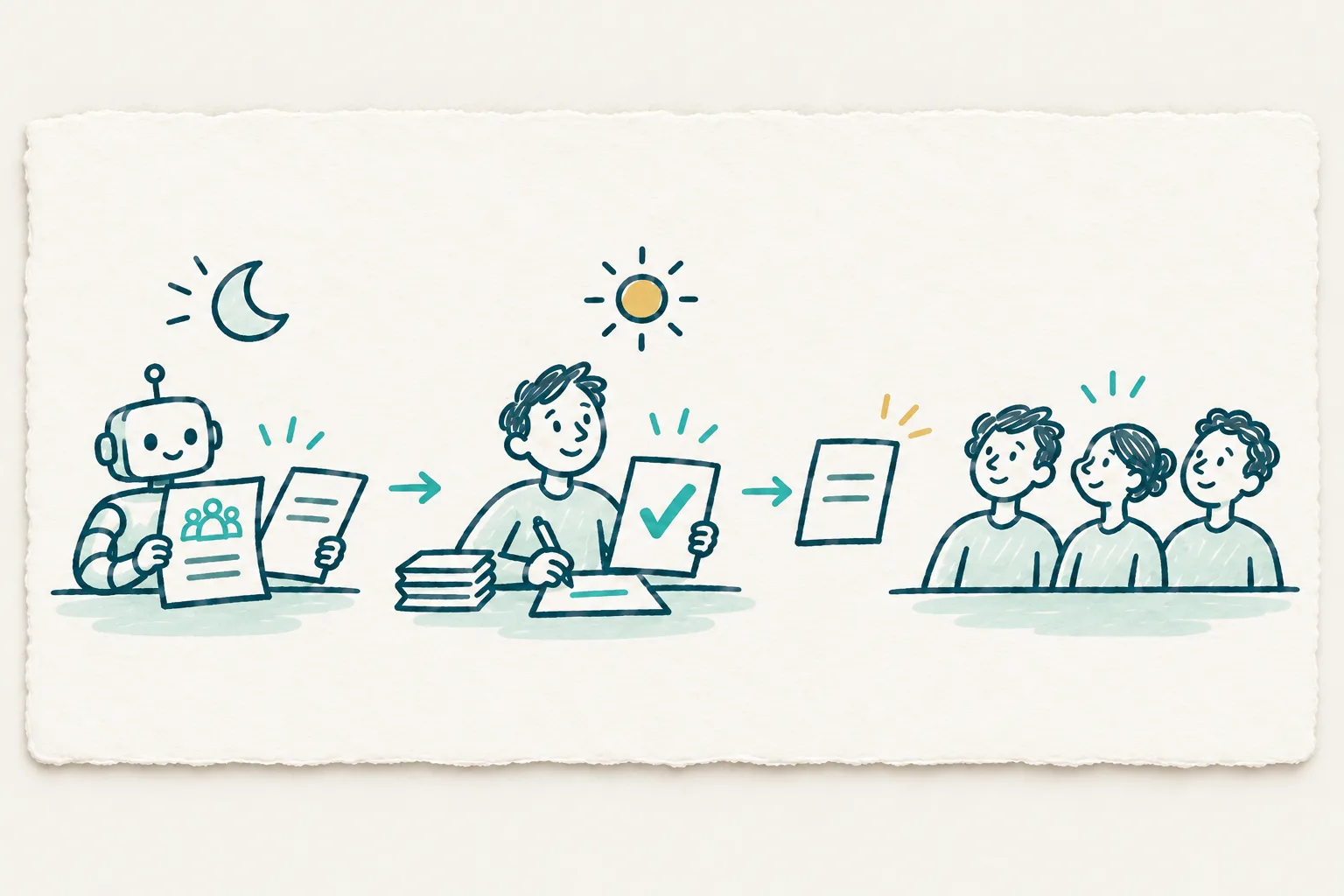
How the workflow can work
- Your voice gets written down
We build a short voice guide from your best past posts, emails and recorded calls: the words you use, and the ones you never would.
- Ideas come from your week
Overnight, the AI employee reads your call notes, client wins and chosen news sources, and suggests post ideas tied to them.
- Drafts wait for you
Each morning, first drafts in your voice wait in your review queue in The Synergy Hub. You polish, approve or discard each one.
- Edits teach the next draft
Your changes are kept, so drafts need fewer edits over time. Nothing is published without a person's approval.
Questions to answer before implementation
Where do you publish today, and how often?
Which of your past posts or emails sound most like you?
Where do your call notes and recordings live?
Which client wins can you talk about, and which clients must never be named?
Which industry news sources do you trust?
Who approves each post before it goes out?
Which topics, claims or words are off-limits?
How will you know a post worked: replies, booked calls or something else?
What to define in the implementation scope
A written voice guide built from your own posts and calls
Post ideas and first drafts waiting in your review queue each morning
A named approver for every post, and nothing published without approval
A list of topics, claims and client names that are off-limits
Time spent writing each week, measured against where you started in the Diagnostic
These are proposed workflow outputs, not a promise of results or a fixed monthly deliverable.
Map the work before implementing it.
The free Snapshot helps choose one workflow. The paid Diagnostic documents the current process, baseline, ownership, decisions and proposed scope. Nothing is built during the Diagnostic. Implementation requires a separate written scope.
AI Operations Snapshot: Free. AI Operations Diagnostic: $1,000 once for 1 week, documents only; no implementation is included. Partnership Tiers: Direct Advisory at $2,500/month with 4 engineering hours a month; Strategic Partner at $4,500/month with 8 engineering hours a month; Fractional Product Lead at $7,500/month with 15 engineering hours a month. Each tier has a 3-month commitment and no onboarding fee. Fixed-Scope Builds: Workflow Automation $3,500; Team System $7,500; Operations System $14,500; Business Platform $25,000–$50,000, one time, at a fixed price.
It renews for another 3 months at the same price unless you give 30 days' notice before it ends. Renewal reminders and written notice follow the agreement. Licenses, hosting and AI usage are billed separately by the relevant vendors.
Questions owners ask first
- Is AI-generated content bad for SEO?
Not by itself. In February 2023 guidance, Google said appropriate use of AI or automation is not against its guidelines. Using AI mainly to manipulate search rankings does break its spam policies. Google rewards helpful content, however it's produced.
- Do I need to review AI-written posts before publishing?
Yes. Google's guidance on generative AI content tells publishers to fact-check and review all AI-generated content by hand before publishing, because AI predicts likely words rather than checking facts. Nothing we set up publishes until a person you name approves it.
- Do customers care if AI wrote something?
Many do. In a Pew Research Center survey of 5,023 US adults in June 2025, 76% said it is extremely or very important to be able to tell whether text, pictures and video were made by AI or by people.
- Can AI write in my own voice?
It gets close when it has real material to learn from. We start with a short voice guide, your best past posts and your own call notes. Every edit you make is kept, so the next draft needs fewer.
- Where do the post ideas come from?
From your own work. The AI employee reads your call notes, recent client wins and the news sources you trust, then suggests ideas tied to them. Client names stay out unless the client has agreed.
- How often should a small business post?
As often as you can keep it useful. A steady weekly rhythm you can keep up beats a burst that stops. Drafts waiting for you each morning make the rhythm easier to hold.