
CSS frameworks · Framework 05 of 08
Write It Once
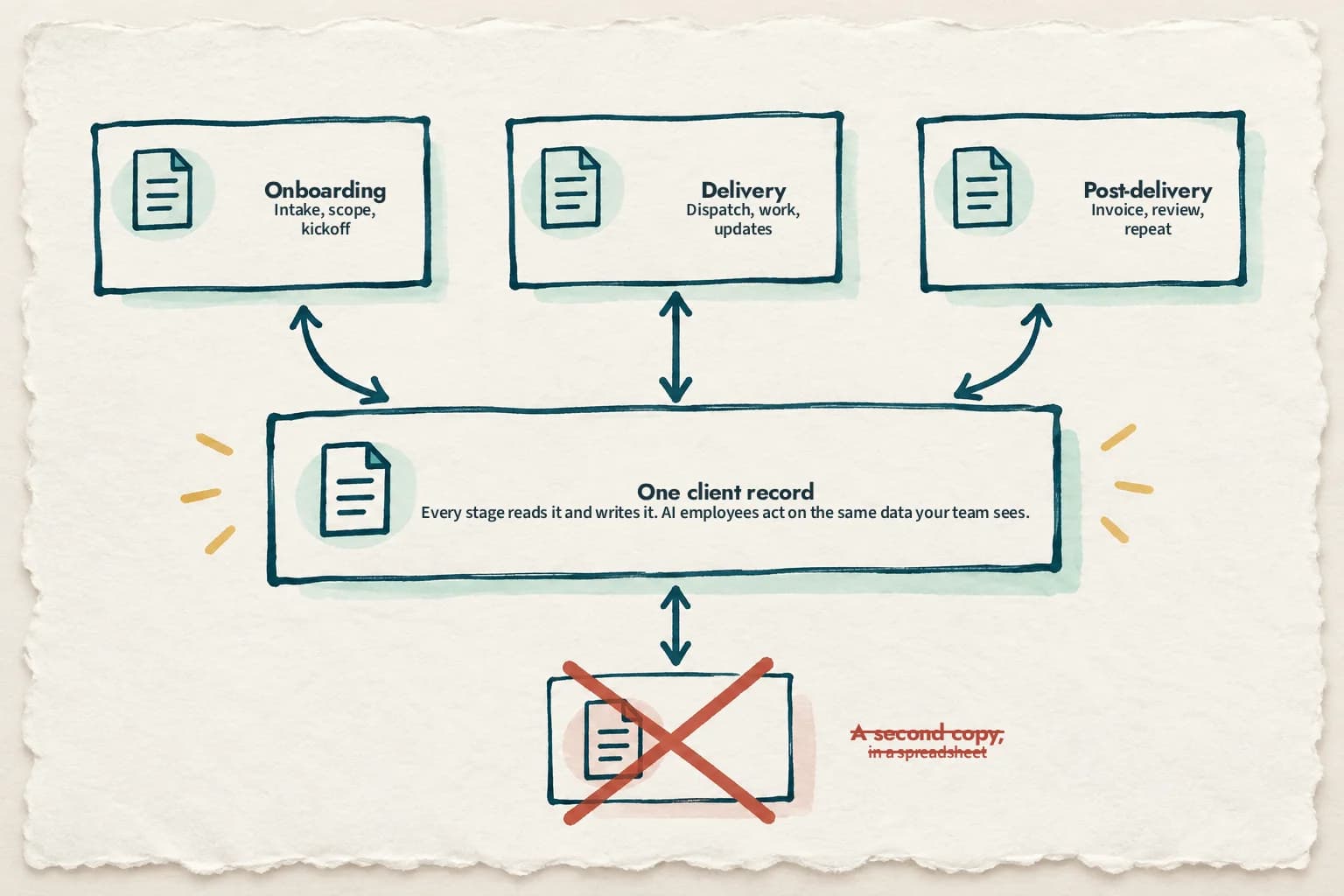
Each stage of the client journey reads and writes one record. A fact that lives in two places will be wrong in one of them, and you will be the person who notices.
Why it matters
Re-keying isn't a typing cost, it's a trust cost. When the schedule says Thursday and the invoice says Wednesday, someone calls the owner to find out which is true. Every copy of a fact is a future phone call.
One record per client, read and written by onboarding, delivery and post-delivery alike, is what lets your team and your AI employees act on the same truth without asking you.
How we apply it
- The Sprint's tool and data inventory names where each fact lives today and how many copies exist.
- We pick the record: usually your CRM or job system, sometimes a trusted-record table we build.
- Every connector and every build we ship names the record it reads from and writes to. A second copy is a defect we log.
- Spreadsheets that held copies are retired, one at a time, as the record proves itself.
The number
| Measure | Cadence | Baseline |
|---|---|---|
| Re-keying events per job or client | Monthly | Sprint operating baseline |
| Facts with more than one copy | Quarterly | Tool and data inventory |
| Status questions that reach the owner | Monthly | Owner Tax count |
Who is accountable
We name the record in writing before building.
If a copy we created falls out of sync and reaches a customer, we fix it and the cause at no charge.
You keep the record in your own account, in your own name.
Where you meet it
Custom Build, where the single record is the first thing agreed in the Envisioning Workshop; and the Spreadsheet-to-System Kit for the DIY version.
A common question
Write It Once, asked and answered.
Does this mean replacing our software?
Rarely. Most businesses already own the right record and have been copying out of it. We connect to it rather than replace it.