
CSS frameworks · Framework 06 of 08
The Payback Rank
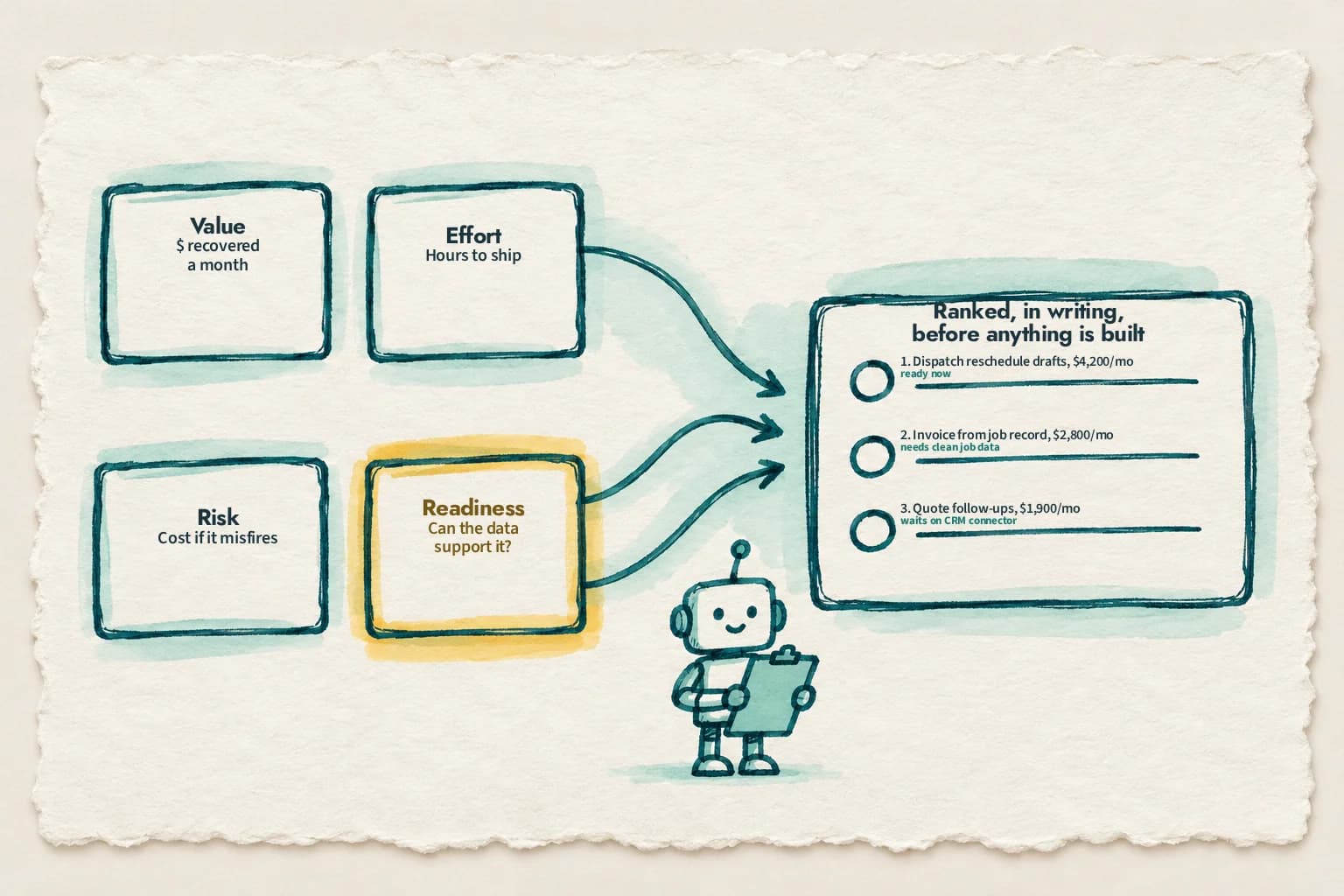
Every fix is ranked on dollars recovered per month, effort to ship, risk if it misfires, and whether your data and tools can support it today. Readiness is the score most consultants skip, and the one that sinks projects.
Why it matters
The most valuable fix is rarely the first one to do. If the data behind it is in four spreadsheets, a quick win elsewhere funds the cleanup.
Ranking in writing, before anything is built, is what stops a project from drifting to whatever was technically interesting that week, and what lets you check at 90 days whether we were right.
How we apply it
- The Sprint produces three candidate fixes, each scored on the four criteria with the evidence beside the score.
- Readiness is a gate, not a score: a fix the data can't support yet is ranked below one it can, whatever the value.
- The ranked list, with projected payback per month, goes in the readout. That is the order we work in.
- At 90 days we compare projected to realized payback and re-rank the remaining fixes.
The number
| Measure | Cadence | Baseline |
|---|---|---|
| Projected payback per fix, $/month | At the readout | Sprint operating baseline |
| Realized payback per fix, $/month | At 90 days, then quarterly | The projection |
| Fixes delivered in ranked order | Quarterly | The readout |
Who is accountable
The rank is in writing before anything is built.
If a fix we chose misses its projection by more than half at 90 days, we say so in the report, re-rank, and the next fix's scoping is on us.
Where you meet it
The Sprint readout, deliverable 4, and every monthly improvement pick in AI Implementation.
A common question
The Payback Rank, asked and answered.
Who sets the dollar value on each fix?
We do, from your Sprint baseline, with the arithmetic shown. You can challenge any number before the rank is final.