Why it matters
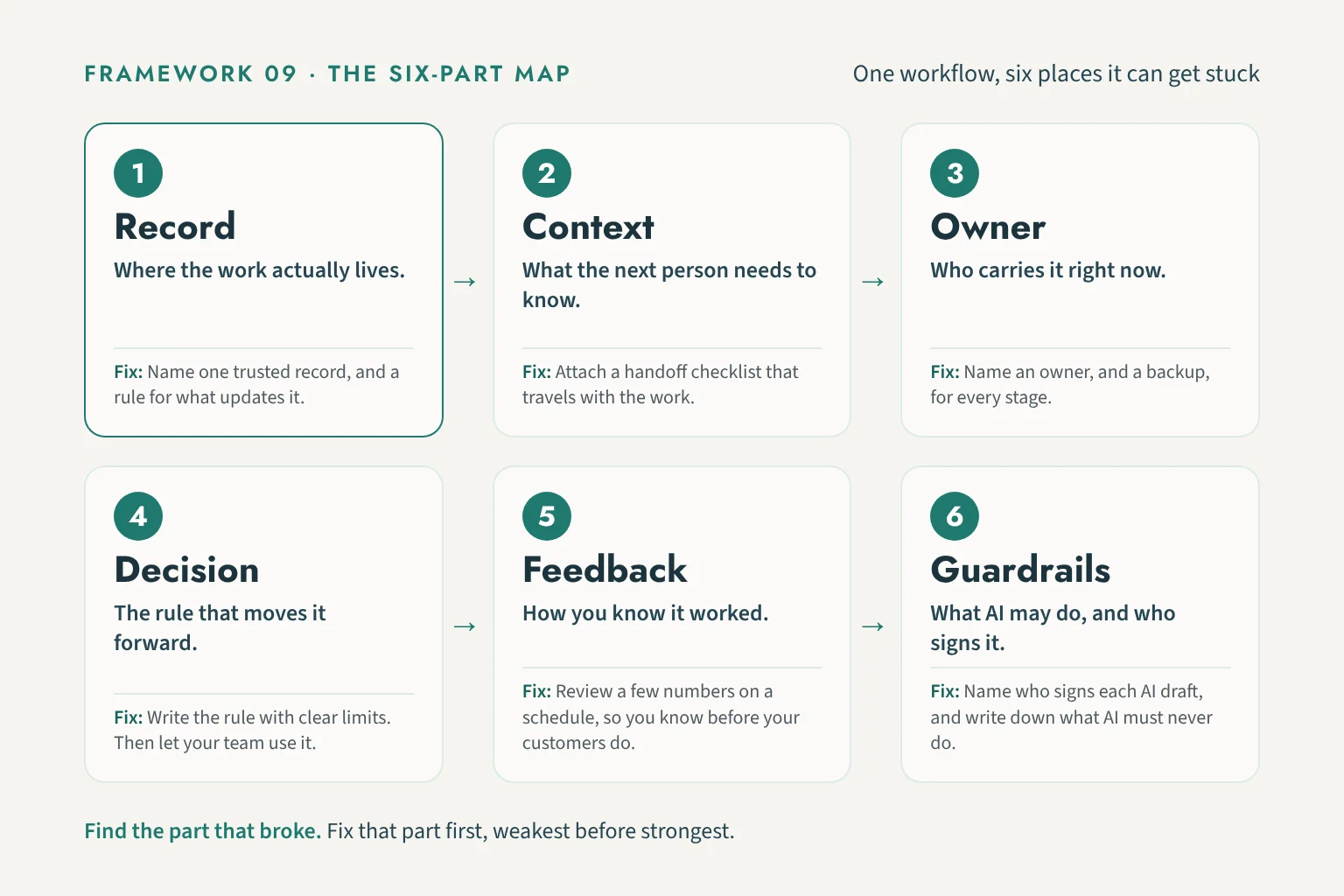
When work stalls, it's tempting to buy a tool or hire a person. Usually one of six things is missing, and the new tool inherits the gap.
If you have to check two places to know the truth, you don't have a record. You have a guess. A handoff without context turns into a phone call to you later.
AI makes the map matter more. It drafts from the record, follows the written rule, and needs a named person to sign. A missing part shows up faster with AI than without it.
The six parts
- 1Record Where the work actually lives.
- 2Context What the next person needs to know.
- 3Owner Who carries it right now.
- 4Decision The rule that moves it forward.
- 5Feedback How you know it worked.
- 6Guardrails What AI may do, and who signs it.
1Record
Where the work actually lives.
If you have to check two places to know the truth, you don't have a record. You have a guess.
How it plays out
4:40 on a Tuesday. A customer calls about their quote. The CRM is blank. The real price is in a text from a job site. Three apps, one question. Multiply that by every call this week.
- Trades
- Job notes on a tech's phone, the quote in email, the schedule on a whiteboard.
- Firms
- Client documents split across email, the portal, and a shared drive.
- Agencies
- Briefs in Slack, approvals in email, files in three folders.
The fix: Name one trusted record, and a rule for what updates it.
Where AI fits: AI can suggest where emails and documents belong. Your team checks them before the record changes.
2Context
What the next person needs to know.
Every handoff without context turns into a phone call to you later.
How it plays out
The sales call promised a Friday finish. Nobody wrote it down. The crew booked Monday. The customer didn't call the crew. They called you.
- Trades
- The gate code, the dog, and “use the side door.”
- Firms
- Why the return is on extension, and what the client already sent.
- Agencies
- What the client hated in round one.
The fix: Attach a handoff checklist that travels with the work.
Where AI fits: AI turns the call notes into a handoff summary, so the crew sees the Friday promise before they book Monday.
3Owner
Who carries it right now.
“Probably me” isn't an owner. It's a bottleneck.
How it plays out
Three people saw the overdue invoice. Each one figured someone else had it. Sixty days later it lands on your desk with a sticky note.
- Trades
- The follow-up on a quote that went quiet.
- Firms
- The missing W-2 in the middle of March.
- Agencies
- The renewal nobody chased.
The fix: Name an owner, and a backup, for every stage.
Where AI fits: AI can flag overdue work for its named owner, with exceptions routed to you.
4Decision
The rule that moves it forward.
When every exception comes to you, the whole team has to wait.
How it plays out
A customer asks for 10% off. Your best tech says, “Let me ask the boss.” You're on a ladder across town. By the time you call back, they've booked someone else.
- Trades
- Discounts, rush jobs, warranty calls.
- Firms
- Scope creep, fee exceptions, late documents.
- Agencies
- Extra revisions, rush fees, refunds.
The fix: Write the rule with clear limits. Then let your team use it.
Where AI fits: AI applies your written rule and drafts the answer. A person approves it. Only what the rule doesn't cover comes to you.
5Feedback
How you know it worked.
If a customer tells you before your numbers do, you're flying blind.
How it plays out
The new intake form broke on a Thursday. Nobody noticed. Two weeks later a customer emails: “Did anyone get my request?” How many people didn't email?
- Trades
- Callbacks, rework, and days from job done to invoice sent.
- Firms
- Returns waiting on the client, and for how long.
- Agencies
- AI drafts a person had to rewrite.
The fix: Review a few numbers on a schedule, so you know before your customers do.
Where AI fits: AI can flag unusual numbers or failed checks for a person to investigate.
6Guardrails
What AI may do, and who signs it.
An AI draft that nobody is named to sign is a message nobody checked.
How it plays out
A new tool drafts appointment reminders. It's fast, so after a week nobody reads them. On Friday it tells a customer their job is Tuesday. The schedule says Thursday. The customer takes Tuesday off work.
- Trades
- Quotes, discounts, and anything that touches a price.
- Firms
- Anything that reads like tax or legal advice.
- Agencies
- Anything sent under the client's name.
The fix: Name who signs each AI draft, and write down what AI must never do.
Where AI fits: AI drafts. A named person approves before anything goes out, and a signed Never List says what AI never touches.
Illustrative scenarios built from common patterns, not client stories.
How we apply it
- Score it. The free Snapshot scores each part from 0 to 2 for one workflow in 15 minutes, and shows what your clients notice at each gap.
- Check it. The Diagnostic checks the map with your team and your real records, then names the weakest part as the first fix.
- Fix the weakest part first. Record and Decision come before any AI drafting. Guardrails come before anything goes live.
- Keep score. After launch, Feedback is the part we keep measuring: a few numbers on a schedule, so you hear about problems before your customers tell you.
The number
| Measure | Cadence | Baseline |
|---|
| Parts scored Strong, out of six | At the Diagnostic, then quarterly | The Snapshot or Diagnostic score |
|---|
| Places the team checks to know where work stands | At the Diagnostic | Counted with your team |
|---|
| Problems a customer reported first | Monthly | Target zero |
|---|
Who is accountable
We score all six parts in writing before we recommend any build.
The weakest part is the first fix, even when the fix is a written rule and not software.
Where you meet it
The free Snapshot scores the map for one workflow. The Diagnostic checks it with your team and names the first fix.