
CSS frameworks · Framework 03 of 08
Rules Before Robots
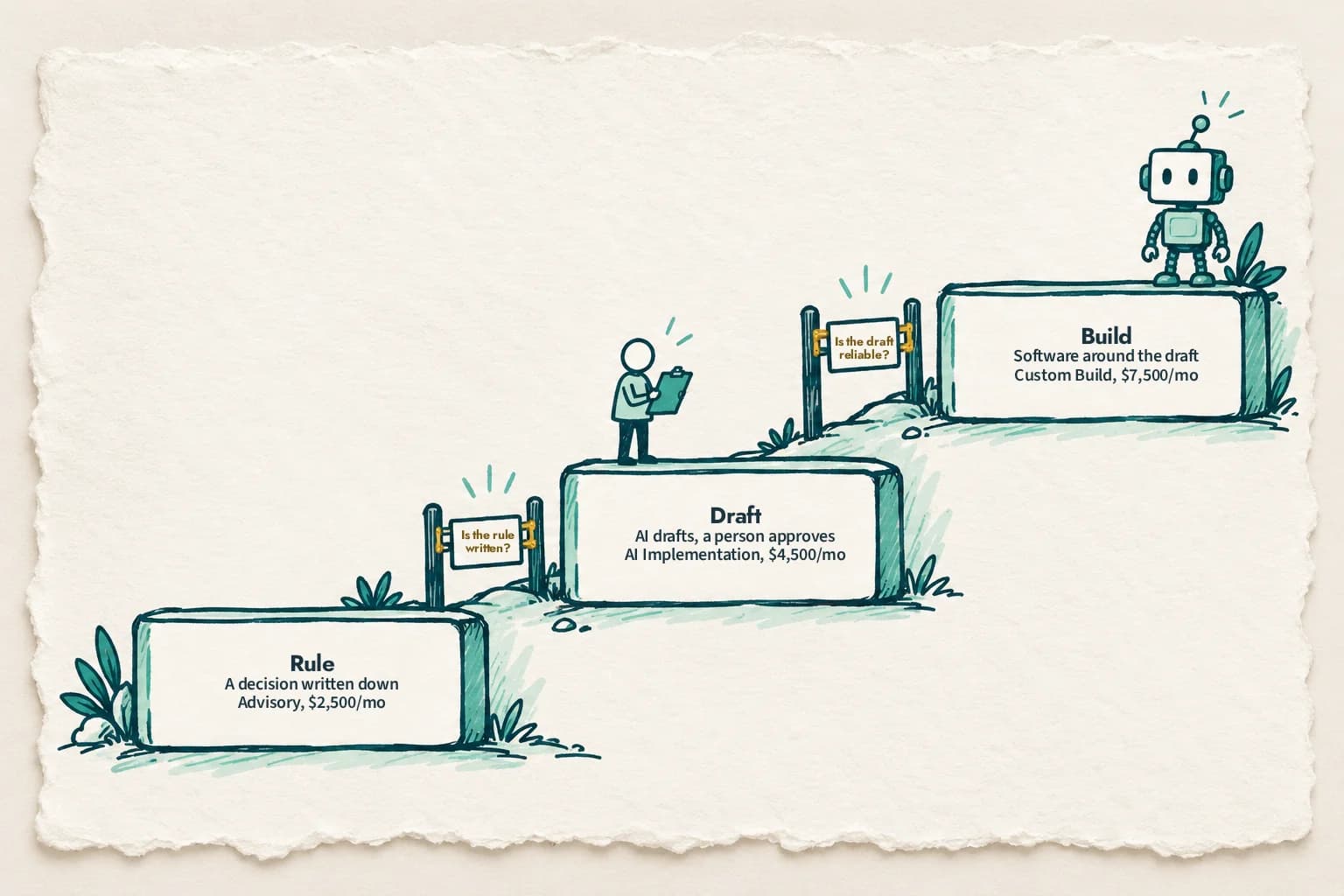
A decision that isn't a written rule can't be drafted by AI, and a draft that isn't reliable shouldn't become software. Work climbs one rung at a time.
Why it matters
Owners usually arrive wanting the top rung: an app, an AI employee, something built. Most are one written rule away from the result they want to buy a build for.
Skipping rungs is how a business ends up paying for software that automates a decision nobody could explain, and then paying the owner to override it.
How we apply it
- Rule. The call that waits on you most is written down so your team can make it. If that alone clears the queue, you stop here. (Advisory.)
- Draft. Once the rule is stable, an AI employee drafts the work the rule governs, and a named person approves it. If the drafts are reliable, you stop here. (AI Implementation.)
- Build. Only when the draft is reliable and the volume justifies it do we build software around it. (Custom Build.)
- The Sprint readout names your rung. We don't sell a higher one than the readout supports.
The number
| Measure | Cadence | Baseline |
|---|---|---|
| Decisions moved from the owner to a written rule | Monthly | Decision-rights map, Sprint |
| Rules now drafted by an AI employee | Monthly | Zero at start |
| Rung the business is on, per workflow | Quarterly | Sprint readout |
Who is accountable
The readout states the rung in writing before any plan is sold.
If we recommend a build and the Envisioning Workshop shows a rule or a draft would have done it, we say so and re-scope down, with the difference credited.
Where you meet it
The plan ladder itself.
A common question
Rules Before Robots, asked and answered.
Can we skip straight to a build?
Yes, if the Sprint shows the rule and the draft are already stable. Most businesses find they aren't, and that the rule alone recovers most of the value.