
CSS frameworks · Framework 01 of 08
The Owner Tax
Every time you touch a job or client that someone else could have handled, the business pays a tax. We count it, price it, and track it down.
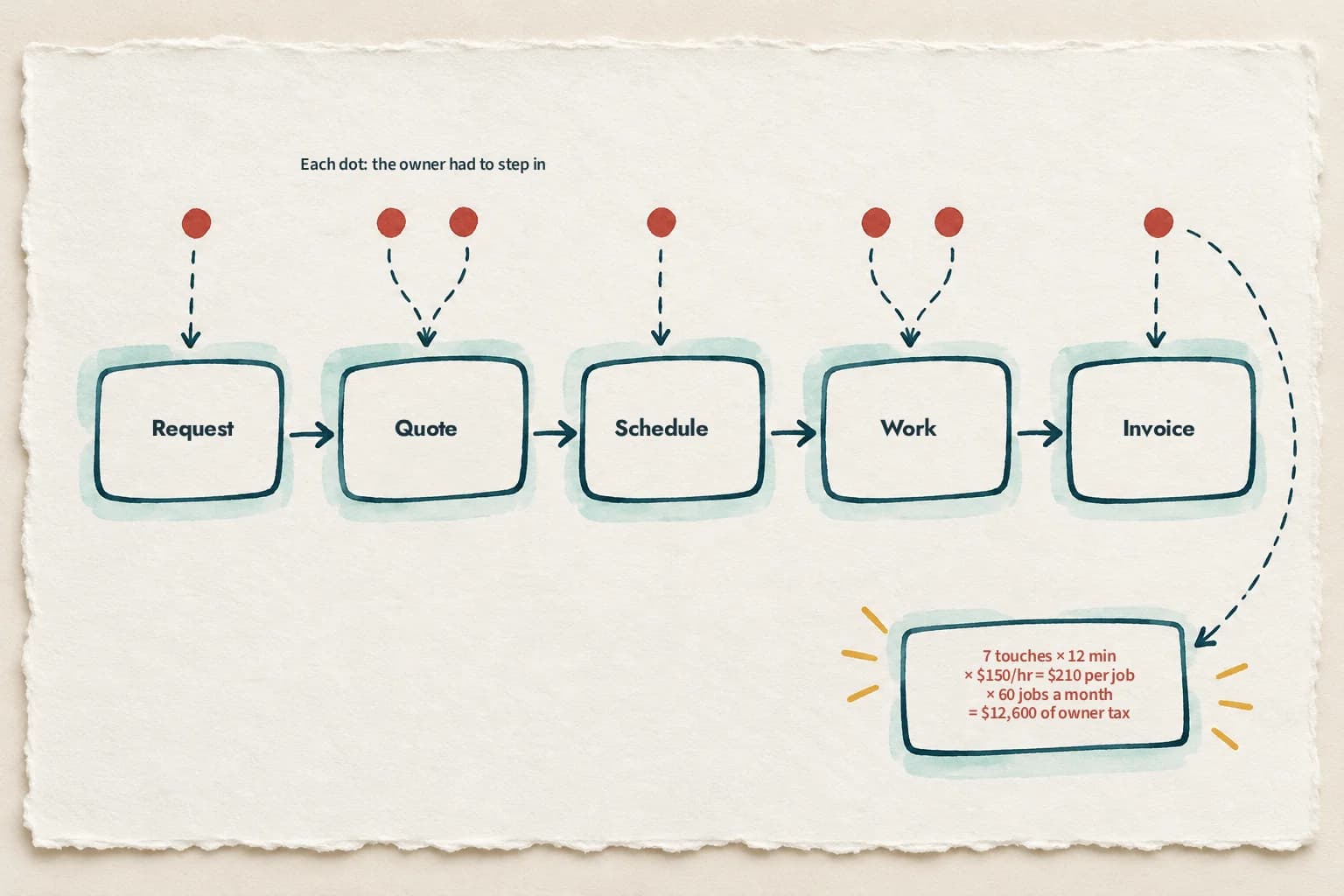
Why it matters
You are the most expensive person in the business, and the queue that forms behind you is more expensive still.
A reschedule that waits two hours for your reply costs a tech a slot, a customer a callback, and the office a re-key. The tax is paid in your hours at your rate, plus everything that waited.
How we apply it
- In the free Snapshot we trace one workflow from first request to paid and mark every point where you had to step in.
- We multiply touches by minutes by what your hour is worth, then by your monthly volume. That is the tax, in dollars, on one workflow.
- In the Sprint we measure it properly, with sources, so it becomes your baseline.
- Every plan reports it monthly. Advisory lowers it with decision rules; AI Implementation lowers it with drafts you no longer write.
The number
| Measure | Cadence | Baseline |
|---|---|---|
| Owner touches per job or client | Monthly | Sprint, week 1 |
| Owner hours per week on the workflow | Monthly | Sprint, week 1 |
| Dollar value of the tax per month | Monthly | Snapshot estimate, then Sprint |
Who is accountable
We report the Owner Tax every month against your baseline, in writing. You set the target in month 1.
If a plan stops moving the number for two months, we say so and recommend the change, including stepping down.
Where you meet it
The free Snapshot.
A common question
The Owner Tax, asked and answered.
What counts as a touch?
Any point where work stopped until the owner replied, approved, forwarded or re-keyed something. Reading a report does not count; being the reason a job waited does.